
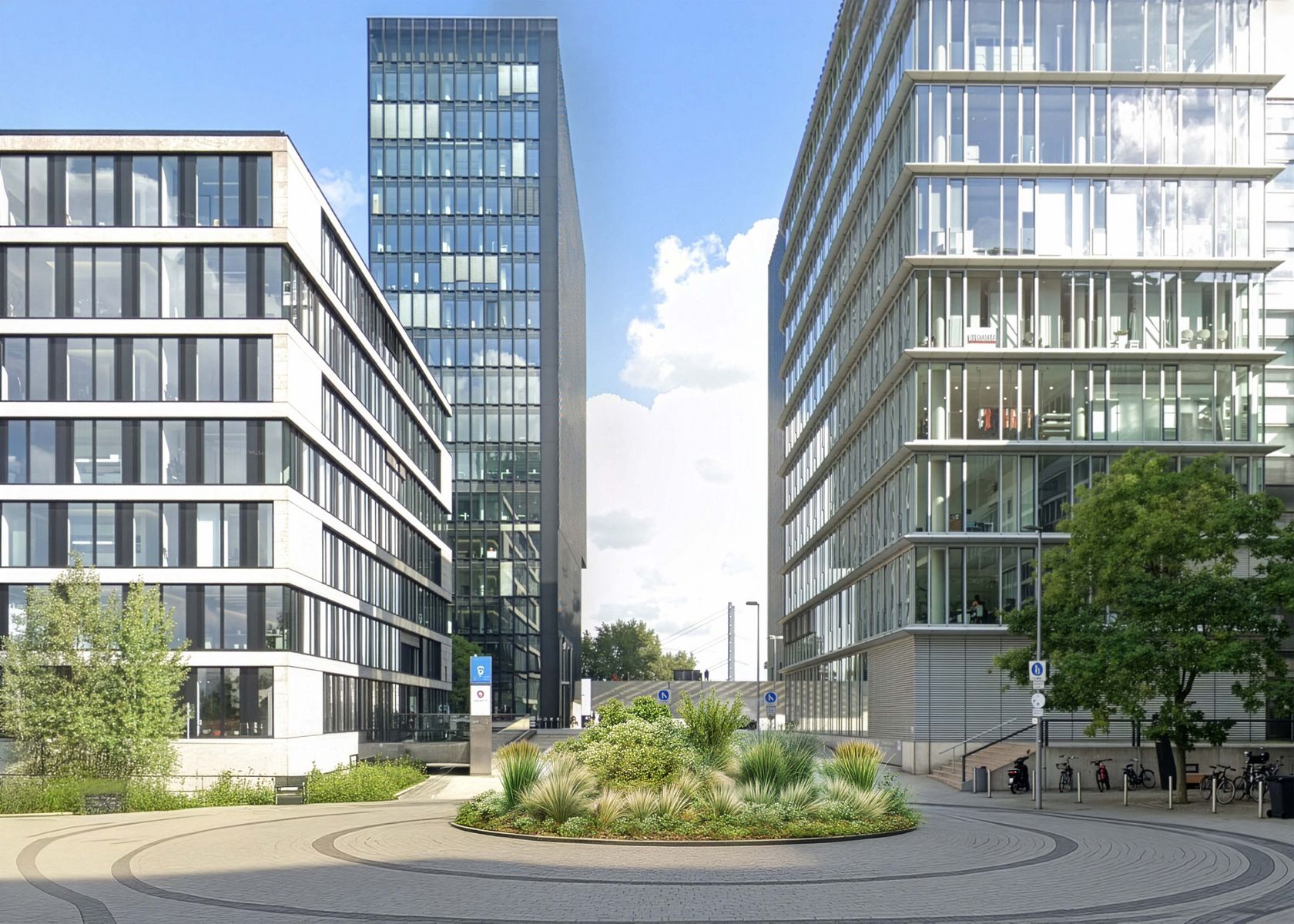
On hot days, this location is one of the most polluted areas in the city. Three years ago, the idea arose to redesign the roundabout as a living bio-catalyst and ecological catalyst for the neighbourhood. With the greening, the location has evolved from a heat pole to a green pulse and is contributing to urban transformation. Despite complex underground pipe networks, the sponge city principle was implemented in a compact area. Perennials and grasses replace asphalt and act as natural water reservoirs. This small-scale unsealing shows how selective measures can improve the urban climate and strengthen biodiversity.
The roundabout greening was initiated by MedienHafen Düsseldorf e.V. and planned by +grün landscape architects in collaboration with HPP architects. The Helmut Hentrich Foundation supported the project, together with other companies. At the inauguration ceremony, Gerhard Feldmeyer (former Senior Partner at HPP Architects) and Jan-Claas Hake (Managing Director of +grün Landschaftsarchitekten) provided insights into the ecological significance of such green islands and their contribution to climate-resilient urban spaces. ‘With a sustainable attitude and a strong community spirit, our city can be actively changed for the better,’ emphasise Christian von Göler (Chairman of MedienHafen Düsseldorf e. V.) and Claudia Berger-Koch (Senior Partner at HPP Architects / Helmut Hentrich Foundation).
Photos: © Werft 6, Hajo Rappe | Visualisation: © HPP/grün


